Click here to view the Oakland Park Adopted and Proposed budgets.
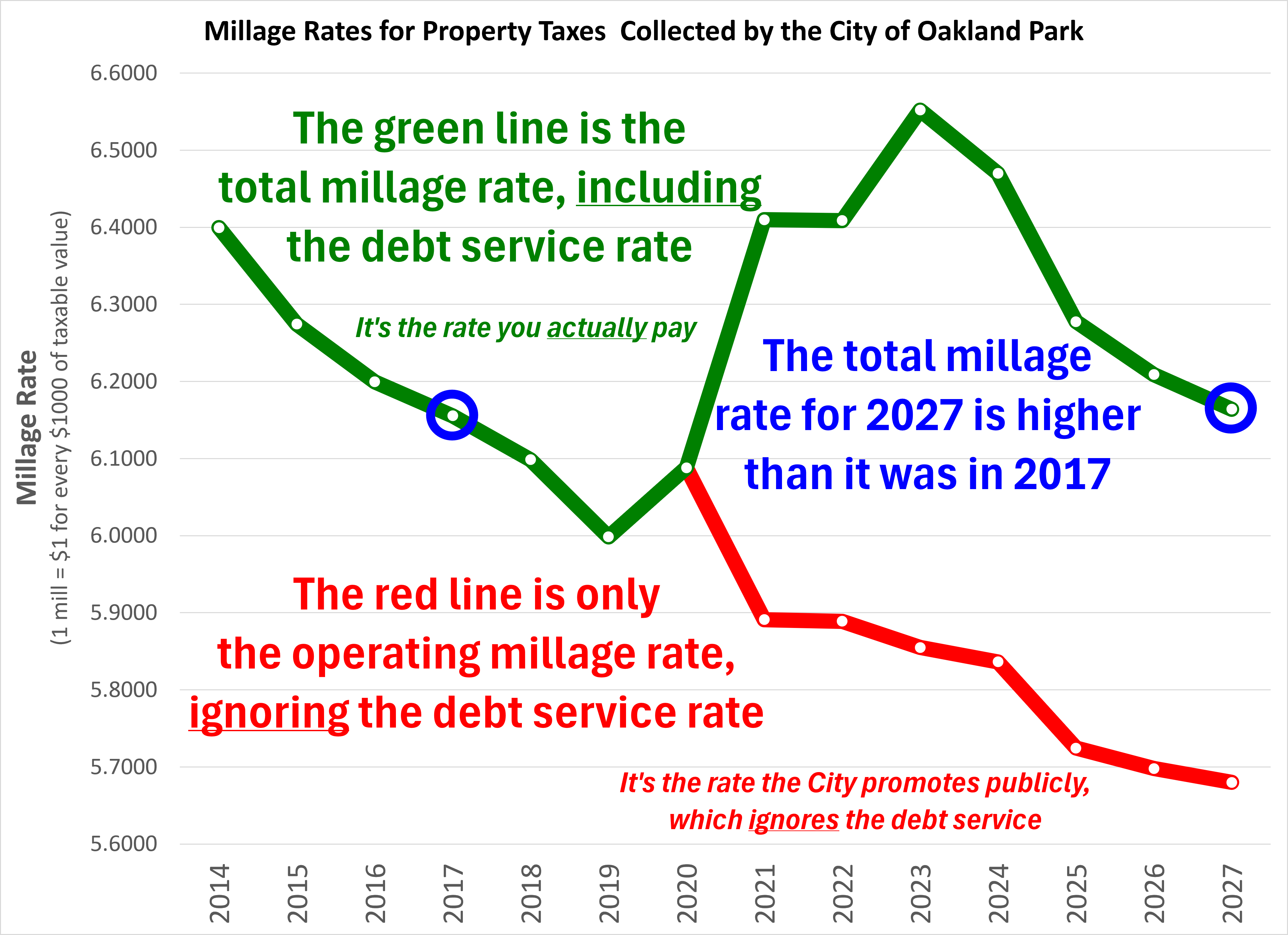
The City of Oakland Park’s recent updates regarding the Fiscal Year 2027 budget contain some celebratory headlines. The city is proudly promoting a milestone: its “lowest operating millage rate in 18 years” alongside a claim that it has “returned more than $22 million to taxpayers.”
While these are attention-grabbing headlines, they serve as a linguistic smokescreen that obscures what is actually happening when it comes to your property tax dollars. Before we celebrate these historic “tax cuts,” let’s take a look at the real numbers and break down the three major pieces of information the city leaves out of its playbook.
1. The Missing Piece: Debt Service Millage
First, the headline-grabbing claim of an “18-year low” only tells half the story. The city achieves this figure by focusing entirely on the operating millage rate, which is dropping slightly to 5.6799 mills—a decrease of 0.018 mills from last year’s rate of 5.6979 mills. What they omit from the main narrative is the debt service millage rate—a levy driven by the $40 million General Obligation Bond passed in 2018. When you add the debt service rate back into the equation to see the total city millage rate, the story changes completely. The combined tax rate actually remains significantly higher than it was in 2018.
2. The Truth About the “$22 Million Return”
Second, the claim that over $22 million has been “returned to taxpayers” is deceptive. The phrasing implies that the city has written refund checks to property owners, which the city has not done. This calculation rests on a hypothetical assumption: if the city had kept its 2014 property tax rate completely stagnant over the past decade, it would have collected $22 million more than it actually did. Labeling an alternative, theoretical revenue calculation as “returning money” to residents is an exercise in creative framing, especially while actual tax bills and the city budget are climbing.
3. Taxes Aren’t Going Down—Revenue is Surging
Finally, the city hasn’t actually collected less tax revenue over the past several years—it has collected significantly more. In fact, the proposed budget is the largest in our city’s history. For FY 2027, the city’s total taxable property value surged by 6.49% to a record $6.62 billion, fueled by a multi-year construction boom and increasing property values.
Because these valuation increases have far outpaced the city’s minor millage rate cuts (which for 2027 amounts to a decrease of 4.48 cents for every $1,000 of taxable value) and have comfortably outpaced inflation—the net result is a significant cash windfall for the city. Property tax revenues are projected to jump to $35.73 million this year alone, up from roughly $33.98 million last year. The city is actually collecting millions more in revenue while touting a fractional rate reduction.
When you factor in these surging valuations alongside rising non-ad valorem assessments for services like fire rescue, stormwater, and solid waste, local property owners will again face a net increase on their overall tax bills this year. A lower tax rate sounds like relief, but the bottom line remains clear: property taxes are going up, not down.